Showing posts with label region. Show all posts

Tuesday, March 10, 2009

Bale Morrow

Part peatland, part bog, part moor, this region lies to the east of the Ten Princedoms, west of the Flordlands, and north of the Central Valley. In Bale Morrow, the sky is eternally overcast, and the ground moist, making camping difficult. Even the most stalwart travelers find the land uncomfortable.

This region is also infamous as the last known location of many an adventurer. It is said a chill wind passes over Bale Morrow at night, catching wanderers in its icy grip and drowning it in the shallow, murky waters that dot the landscape. Indeed, flying Vs, wargoyles, and even wyrmholes patrol the night skies, and wolves, trolls, and giant caterpillars are known to stalk the grounds.

One reason adventures venture into Bale Morrow is for the unique muds, mosses, and foliage. The bogmoss is a natural curative, and can be harvested to make healing salves and tinctures. Morrow mud is a beauty aid, and the various wildflowers and small shrubberies produce flowers and berries that top the reagent lists of many a mage. Even the still water itself is prized, even though it is a low-grade poison if consumed.

It is rumored that there are settlements toward the center of Bale Morrow, but none in the known world has made it both to and from the center of the vast region.

Approaching the vast mix of bog and peat from the west, the last tree before Bale Morrow is known as Lone Tree, and it is avoided by birds and animals of all types. It is as if they can sense the corruption in the land. Poisoned by the waters that have seeped into its roots, Lone Tree has not had leaves upon its branches in years.

Thursday, March 20, 2008

The Middle Kingdoms

Geography
The lands commonly referred to at the Middle Kingdoms are bordered on the east by the Kitel Woods, the north by vast steppes, the south by badlands and the tail of the Skullcrush Mountains, and stretch west to mountain-encircled Lake Abernath. The region consists of ranges of low mountains, interspersed with rivers and generally descending as the water flows east towards Soguer and the Soral Sea.

The Daren River and roads that follow it are a major route for trade and provide an avenue for goods traveling from all the far-flung shores of the Soral Sea to the tributaries that feed Lake Abernath and the free cities that surround it.

The northeastern portion of the area is marked by wild badlands surrounding a range of rocky, mountainous highlands, which trail off into goblin-infested hills. Further north are cold swamps.

The plains of Dahl in the southwest provide good grazing for the herds of the people there.

Lands and Peoples

A traveler who follows the River Daren north and west towards it's headwaters will encounter the following lands:

Shires of Etela - If one follows the Aet River due west from the Daren they will come into the hills and valleys of the Shires of Erela. The halflings that live here are typical of their kind: somewhat reclusive but generally plain country folk. They are mistrustful of the horsemen of Dhal to their west, citing "unforgotten history." Their lands begin at Aetford, where men, halflings and handfuls of elves live together by the large stone bridge.

High Elves of Verdone - Thick and quiet, the Verdone Forset seems foreboding to many who pass it on the River Daren. The tales of the uncaring elves that dwell within and their strange magics are whispered by boatmen. Few have seen their white towers, for the wood is said to be enspelled to confuse the minds of men and lose them among the tall, silent trees.

City of Devin - This city and it's fortified castle grow large on the trade here at the meeting of the Rivers Bedeflow and Daren. A diverse city, it includes large populations of gnomes from the mountains to the east, elves from Verdone and halflings from the shires to the south.

Dhilic People - The men here are known to be superb horsemen and warriors, a tradition that is celebrated in passed down from father to son. They ride the plains of Dhal on their fine fast steeds herding their cattle, goats and sheep. In the villages in the hills surrounding Keep Dhilia they make leather goods and weave picturesque tapestries to warm their homes against the winter winds.

City of Argros - Vast fields of grain grow in the lands surrounding Argros. The peoples here tend to build their homes raised on posts to help them survive the spring floods of the Daren. Traditionally all landowners serve as pikemen in the militia, territorially guarding their borders from the men, gnolls, half-orcs, and wood elves surrounding them.

Marble Falls valley - Mining dominates this deep mountain valley and the small cities here. Mist from the many waterfalls clings to the leaves of trees in the ravines carved by the water's slow hand. Fine stone gives the area it's name. Animal sculpture is popular, and most homes have at least one large stone statue near the entrance to ward off evil spirits. The area is also noted for a large, beautiful shrine to WeJas, goddess of death and magic, carved into a cliff face in the northeast of the valey. Within the shrine is a huge marble statue of her opening the door to the next world for the departed.

Free Cities of Abernath - The shores of Lake Abernath are dotted by human cities, each a city-state unto itself. Farming, fishing and trading on the lake are the pillars of their economies. Mercantile and guild conflicts occasionally spill over into violence here, but actual war between the cities is generally seen as being bad for business.

Dwarves of Rolang - In the mountains on the eastern shore of Lake Abernath, the dwarves of Rolang delve into the bones of the mountains. Brass and iron are traded from here, and also grains that they turn into casks of their famous dwarven ales.

Elves of Forla Wood - This area is home to a large concentration of the semi-nomadic wood elves that move their homes all around the region. Every year representatives from each family meet in the sacred Emerald Grove to discuss issues important to the elves of the land. Bards from Forla's tribes, while rare, are welcomed in all cities of the Middle Kingdoms for the news they bring and their exceptionally beautiful music.

Queen Zedhrev's lands - From lake Abernath, further up the River Voros, at the foot of cold mountains, Queen Zedhrev sits in rulership. Her lands stretch through the swamps east to the Temple of Stars, and west along the R. Voros. It is generally agreed that she is a powerful sorceress, and she is mentioned in many stories and legends in the Free Cities, usually as a cruel and bloody villain.

Temple of Stars - The largest temple to Baccob in the known world, this site is said to be of importance due to it's position beneath certain constellations. Some say the view of the stars from the high hills in the clear cold air is why Baccob blesses this temple. It is only one of the many secrets of this temple. The priests here are on good terms with Queen Zedhrev to the west, and she gives them their solitude and protection from the barbarians and bestial peoples to the east. It is said that they gave her her sorcerous powers. It is also said that they resent and fear her power, and the truth of it is known only to them and her.

In later ages, this temple becomes the site of the final siege of the Anmagus Crusade of the Sword of Light. See also the Cult of Shan'n'nur.

Bare Peaks - The barren mountains of these highlands are home to groups of gargoyles and kenku, and no travelers go here. The gargoyles of this region call themselves the Dz'ata Möschu.

Lord Fevul's Lands - These dry badlands and rough, scrub covered hills are home to various goblinoid tribes, and have traditionally been an evil place to be avoided. Recently, however, the elves living to the east and south have been reporting raiders emerging from this area. They claim that a warlord named Lord Fevul has united the goblin tribes and that Magublet, the goblin god, sits at his side. In times past, the barbarians to the northeast with whom they skirmished, the Kitel Elves, and the swamps and mountins to the west have provided defense against these peoples, but now there are whispers of worry that a great host may soon march out of those brown hills.

Akmak and the half-orc lands - In the lands surrounding the Bare Peaks are scattered villages and small cities of predominantly half-orc people. Their traditions claim that they are descended from an ancient race of warriors, and they are indeed fierce fighters who's walled city of Akmak is a testament to their grim, martial culture.

Dwarves of Sturm Mountain - The dwarf clan that calls this mountain home have built an extensive stronghold deep into the bones of the land. The clan ruler, Oxymazus Axehand rules his people with strict laws adhering to Moradin's dictates. As a people they are extremely unwelcoming to any but their own, and the entrances to their mountian fastness are guarded day and night by dwarves in bright suits of mail.

Tehton - The hills, valleys and forests of Tehton are home to hardworking woodsmen and skilled carpenters with a strong code of ethics. The peoples here also have a close affinity with the various fey in the mountains from sprites to wood elves. Their largest city is called Forston, at a fork where the River Aelle meets the River Bedeflow.


Rumors and Information
The following can be determined with the corresponding Knowledge (local) or Bardic Knowledge check: (leave comments to create the rumors and information)


Tuesday, March 11, 2008

Lands and peoples of northeast Soralia

This post is the first in an series of posts detailing Soralia, a continent you can use as part of your campaign world. I created this land while running several campaigns in it over the last seven or so years, and now that I feel like it's fairly well flushed out, I'd like to share it with everyone on Claw Claw Bite.

This first post gives a broad overview of the norteastern portion of Soralia.

Climate: the northern kingdoms are warmer than their latitude is generally, due to a major warm current that flows north into the Soral Sea, past the northeastern shores of the Princdoms of Ogham, and then west along the northern shore of the Soral Sea. This warm current results in heavy mists and fogs along the coasts of the so-called Pirate Kingdoms that stretch from the eastern edge of the peninsula to the halfling lands in the wide river basin that dominates the central portion of this region.

The Dwarvish lands are high and cold, set in the sprawling Dunheng Mountain chain that shields the eastern lands from the cold north western winds. The gnomish lands are a temperate and fertile land of hills and rivers which flow down from the dwarvish lands. The lands east of there with their small human kingdoms are warmer still in the southern reaches where the warm current runs strong. In the norther reaches they become more temperate as the lands rises slightly towards the arctic barrier mountains. These lands are drier and less fertile than the gnomish lands to the east.


Lands and Peoples: As one travels from west to east from the Fridon kingdoms along the north shore of the Soral Sea, one encounters first dwarvish and then gnomeish lands, followed by a stretch of heavily wooded wilderness, and several small human kingdoms.


Dwarven Kingdoms: two large and several small sovereign dwarven kingdoms claim the Dunheng Mountains and the surrounding land as theirs. Fairly isolate and xenophobic, these dwarven kingdoms have long-running feuds that occasionally break out into brief wars. Smaller kingdoms will be on one side or another as events change over the years.

These dwarves have some commerce with the underdark, primarily with deep dwarves and undergnomes. Other commerce is with occasional Fridon traders from the west and gnomes to the east, and through them, the warm human Pirate Kingdoms. Many young dwarves from these lands hire themselves out as small companies of mercenaries to the gnomes, halflings, and humans to the east.


Gnomish Lands: These lands are primarily gnomeish citiy-states ruled by family clan councils. The population includes a smattering of halflings, dwarves, humans and the occasional elf. Their economies are primiraly agrarian. For defense, the ruling councils use mercenary troops sparingly and wisely to defend against human raiders from the east. As their lands are not rich in precious metals, they tend to be at peace with the dwarven kingdoms of the Dunheng Mountains to their west.

The gnomes that live here tend to be practical, stoic folk, well used to defending themselves from the human bandits that spill out of the Pirate Kingdoms. To their north in the tail of the arctic barrier mountains tribes of Ice Kobolds and the Naahaogo mountain goat people occupy the last habitible stretch of land before the tundras and arctic wastes. Mixed among them in the rolling foothills west of the river basin are several small halfling, elven and human communities.


Pirate Kingdoms: Collectively known as the Pirate Kingdoms, these are small and factious kingdoms that stretch out across the end of the northern Soralic peninsula. On the whole, they tend to be somewhat poor and rather chaotic. Due to the laxness of laws in this region, they are a haven for pirates for which they are known.

One kingdom is ruled by the famous Mad King of Pitosala, a small state in the Pirate Kingdoms. Cursed with a split personality, his fits and shrewdness are famous. His main personality is an Aristocrat 10, regal and charismatic, and his next dominant personality is Wizard 10, shrewd, cruel and scheming, with a third personality which is a babbling mix of voices....

The humans here tend to view dwarves with a bit of distrust, as their main contact with them is as mercenaries.


Ice Kobolds: These Kobolds have a blue-white color to their scales and a natural resistance to the cold (cold subtype: cold immunity). They worship the white dragons that live on the arctic shelf and throughout the barrier mountains. There is enmity between them and the beast-men that share these mountains, but they do not tend to make war on each other. They come into frequent conflict with the gnomes and to a lesser extent with the dwarves that live in the Dunheng Mountains to the southwest of them.

Their king is a fighter 5, sorcerer 8, dragon disciple 5. Also of note among them is a powerful sorcerer (18?) who builds fantastic constructs for use as war machines, some in the aspect of the dragons they worship. He often must work with other magic-users to complete these constructs, but has the support of the king and good access to the resources he needs.


Beast Men (Na'ah-aogo): Known as beast-men by their human neighbors, but calling themselves the Naahaogo, these creatures dwell in the barrier mountains north at the headwaters of the river that flows through the wild woods separating the gnomes and humans. They are thought of as dangerous savages by the humans south of them, and have fought settlers and raiders from the human kingdoms. They are organized into small family units and are primarily nomadic gatherers.

They have the aspect of men with the head and hind legs of a goat, with a thick pelt of fur across their entire bodies, giving them good resistance to cold weather. They receive a +4 racial bonus to jump, climb and balance checks and are well suited to the mountain terrain in which they live. They receive a +1 racial adjustment to dex and con and a -2 adjustment to intelligence and -1 to charisma. Their favored class is ranger, but scouts, druids and barbarians are common among them. Their society tends to be neutral and slightly chaotic as do individuals. They fight with longbows and spears, though their warriors favor many weapons such as greataxes, greatswords and longspears.


Rumors and Information
The following can be determined with the corresponding Knowledge (local) or Bardic Knowledge check.... (use the comments section to add rumors for this region)

Saturday, January 12, 2008

Goduanil

Pronounced Go-do-ann-ill, this is a region of bleak hills where the sky is always overcast, which end in cliffs that overlook the Olde Bay in the center of its north shore. In the valleys run wide streams of black pudding and other oozes, fungi and molds are common.

Goduanil stretches for many miles along the rocky coast and runs almost to the Swift River Road which parallels the river up onto the Cyrűk Mountains.

Locations and encounters within Goduanil include:
* Pryad Wastes
* Black Pudding Streams
* Oozes, Fungi and Molds
* Griffon Roosts
* Waste Giants

Locations of interest to the party include:
* Arthens Lighthouse
* Various ancient ruins sites
* The mysterious tower ruins where rumor has it a wizard went to hide

Thursday, August 30, 2007

Marsh Tides

Beware the tides of marsh!

This region in Wastaru is filled with mashlands and barrier waters. Looming overhead is a ring of volcanoes which constantly simmer, causing the water to heat up and the local bestiary to panic and stampede. The droopy trees in the marshlands extend out into the ocean about 1/2 mile off of the shore, wherein the water has a black hue and a tar-like consistency. There is death in those waters.

The marsh tides are the home of the kakataur, a prehistoric alligator/lizard/dinosaur beast. These creatures are very deadly, as they blend in to the wilderness and attack with monstrous fangs behind 1/2 ton frames.

The marsh tides are also the home of the slithe, a great serpent of the marsh. These creatures sneak up and then wrap their 20' long, slender bodies around their prey, leaving them no hope of survival.

The tides rise and fall, leaving the area well ventilated and constantly altered. The paths through the marsh change with each tide, so humans rarely venture into this region, and almost never make it out alive.

(map to follow)

Wednesday, July 18, 2007

The Phyloctæte

This empire was once ruled by a council of four powerful mages, who, in their lust for control, ended up waging war with one-another in a three month period which has been come to be known as the Four Mage War. Nestled in between three other human-controlled lands, their war bled over into neighboring lands, with mages flying through the air, wyrms and other creatures battling across the lands. This made the Phyloctæte a feared land in bard's tales, and to this day, people fear the regime of the victor, Feryn Dyndle, who shares her human lineage with that of the elves. Some people have spread rumors that full-blooded elves from faraway lands had something to do with her success in wresting control of the Phyloctæte from the other, full-human mages.

At the end of the war, one of the mages was killed, another sought refuge in the Astral Plane, and the other surrendered to Feryn Dyndle.

To the northwest of the Phyloctæte, across the Windplains, lies the Kingdom of Altæa. King Harald Altæa has no patience for the war that has affected villages in his domain.

To the west, over the Mountains of Insor, lies the relatively peaceful, multi-racial democratic republic of Nelshun. The Phyloctæte has had few dealings with Nelshun, so it remains to be seen how the new ruler will be received.

To the south, the militaristic Republic of Esrun controls the vast plains of Yæns. Esrun has for years planned to move on the Phyloctæte, and now may be their chance, with the council at it's weakest. Rumors have it that they have stepped up production of swords and spears, and have recently domesticated some Yæns horses, which make powerful mounts.

To the southeast, through the Border Forest, the Ten Princedoms have formed out of the old Kingdom of Vandor, following the death of King Vandor.

The people of the Phyloctæte have grown weary of the Four Mage War, and have welcomed the recent cease-fire. They are busy rebuilding the towns and villages that make up their nation. Many of them could care less who rules the land, as long as they are left to their arts, crafts, and other skilled trades. Many would like to reap the benefits of trading with the neighboring nations.

Meanwhile, Feryn Dyndle is installing her elven brethren as the ministers and administrators of the nation.

Sunday, July 08, 2007

Nagy Tömeg Mountains

The Nagy Tömeg are a Mountain range in the center of the Farghol, the northwest border of the Lands of Northbay, the southeast border of the Central Valley.

Deep in the mountains live Deep Gnomes, though they are not often bothered by the Gnomes who live closer to the surface, so there has been little contact between the groups over the ages.

Surface Gnomes live in caves above ground on the north side of the mountains facing the valley, and have built an elaborate series of mechanized lifts to move goods out of the mountains. These lifts also operate in subterranean mines that dot the range. The raw materials and the goods crafted from these materials are the main source of the local economy.

Much of the interior of the range has not been explored by those friendly with humans. It is rumored that fierce Giants live in the center of the mountains. In addition, the bellows of an ancient wyrm have also been heard, coinciding with thunder and lightning storms that rip through the valley in the spring. These have been isolated to emanating from the side of the range that faces Elsemere Wood, where no humans dare go.

Rivers run down the north side of the Nagy Tömeg into the Central Valley. On the floor of the Central Valley live halflings and quarterlings, also more appropriately called three-quarterlings. There are also a few human settlements in the valley, numbering close to 300 inhabitants.

Wednesday, July 04, 2007

The Jæruel

The Jæruel is a collection of fishing villages, mining towns, and tradespeople united under a merchant flag with three intersecting rings in the center over a brown backdrop with a sinister silver bend from the upper right to the lower left. The towns are officially independent, but they follow the lead provided by Tannen. The Jæruel merchant house which provides the name for the region is much more hierarchical, keeping strong hold over the markets in each of the towns, especially those higher up in the power structure. The only standing army is privately run by the merchants of the Jæruel.

The towns and villages of Jæruel:

- Tannen - capital of Jæruel - bustling port town - what Onuago was built after - full of hides and wines other goods from all over the Jæruel (5,000)
- Piran Point - fishing and trading village (920)
- Flego - fishing village (400)
- Uppwint - named for the strong winds that bring fog and quick shifts in the weather to this quaint fishing village (200)
- Trover - fishing town (400)
- Alabaster - inland named for the stone mined from its cliffs (500)
- Junction - a "middle man's" town at the intersection of trade routes (3,000)
- Himas - a stop on the path of produce to market in Junction (200)
- Franti - wine production, source of Franti grapes (600)
- Furton - wine production, source of Furton grapes, also furs all sent to Tannen (800)
- Ches (pronounced Shez) - fresh water fishing along a broad bend in the river (400)
- Westfort - a fort-like outpost in the mountains to the west of Tannen and Ches that provides hides and timber (200)

Small settlements are developing in the lands to the west of Franti and Furton, but they have not taken significant shape. Some of them have met with ruin due to various invaders -- bandits, goblins, and even nefarious pixies getting in on the raiding action.

Saturday, June 02, 2007

Ettin Lands

At the southern end of the Cyrűk mountains, a strain of ettin have made their home for multiple generations. These two-faced creatures often end up meeting their fate when one of their brethren challenges them to a duel to the death over some misunderstanding.

The Ettin Lands are a series of three tall hills surrounded by the neighboring peaks. Within these borders, ettin law reign supreme, that of might makes right. This way of life has been passed down through ettin culture, a mismatch of orc, giant, and various other mythologies and beliefs. It seems they are continually confused, perhaps due to their multiple heads, which often do not agree. Ettin (especially from this isolated region) have been known to argue with their own heads, sometimes leading to the two halves of the body pummeling the other to the ground. What is strange is watching them go at it -- the right head controls the left side of the body, and vice versa, so the opposing blows must cross one-another in order to contact the intended targets.

Occasionally an ettin will travel outside of these borders into lands inhabited by humans or others of their ilk, but they have largely stuck to this region because of the plentiful supply of large game to hunt. In the neighboring Ettal valley, the meat is much leaner and quicker, making for too challenging a hunt, a major deterrent to this lazy species.

Still, they have been known to hunt men for sport. That is, when they can get along long enough to keep organized.

Recently, the ettin have been haunted by their own zombies, who roam the mountainsides at night in search of brains... ettin technically have two per body, making them even tastier prey to these zombies.

Monday, April 09, 2007

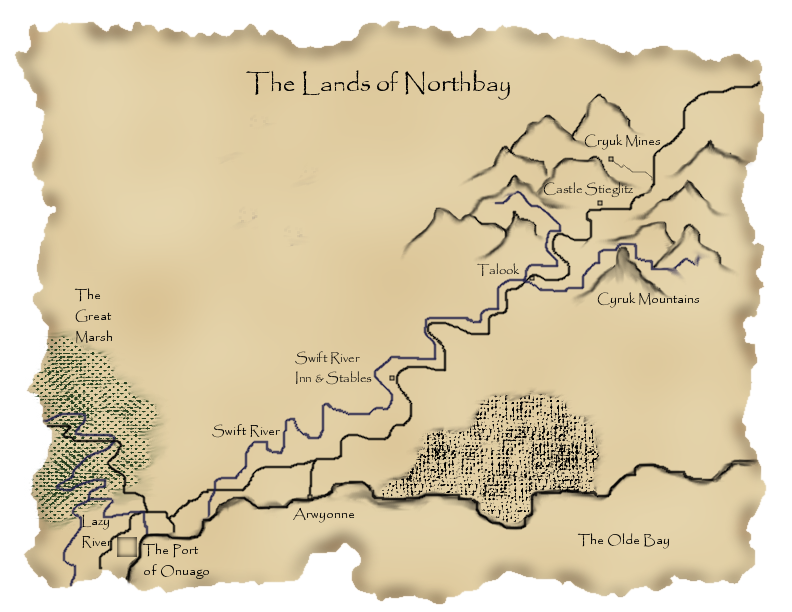
The Lands of Northbay

The Lands of Northbay area covers the stretch of land beginning from the Olde Bay and leading north to the Nagy Tömeg mountains, over which lies the Central Valley. On the northeast edge of the Lands of Northbay, over the Cyrűk Mountains we find the rough fishing towns of the Jæruel a merchant coalition, which to the north begin the Fjordlands, the first part of the Northlands. On the west end of the lands of Northbay past the Great Marsh lies Elsemere Wood, a forest which is mostly pristine, but in recent years has grown partially corrupt on its southeast side.

The Northlands do not have a central government; Onuago and Elsemere are too much on the decline, and the local robber baron Baron von Stieglitz has even disappeared from the public eye. The towns of the Jæruel are the best hope for this region.

Notable locations:
Towns:
* The Port of Onuago - colonial port town which has seen hard times
* Elsemere - Old logging town also on the decline
* Talook - Hamlet on the road through the Cyrűk Mountains and Castle von Stieglitz
* The towns of Jæruel:
- Tannen - capital of Jæruel - bustling port town - what Onuago was built after
- Flego - fishing village
- Uppwint - named for the strong winds that bring fog and quick shifts in the weather to this quaint fishing village
- Trover - fishing town
- Alabaster - inland named for the stone mined from its cliffs
- Arwyonne - abandoned fishing town ten miles east of Onuago

Rivers:
* Lazy River - the source has never been found somewhere within the Elsemere Mountains, passing through Elsemere Wood where it makes its way lazily through the Great Marsh to Onuago where it is channeled around the town and out to the Olde Bay. This river has been known to change course many times over the years, leaving traces of past flows as it does.
* Swift River - passes swiftly, hence the name, out of the Cyrűk Mountains, past Talook, depositing into the Olde Bay a few miles east of Onuago.

Other Geographic Features:
* The Great Marsh - a large, mostly unexplored marsh that occupies most of the land from Elsemere to Onuago.
* Goduanil - bleak moors where the sky is always overcast, which end in cliffs that overlook the Olde Bay in the center of its north shore.
* The Great Elsemere Wood - large forest, mostly unexplored by humans. The upper two-thirds is pristine forest, but the lower third has been corrupted by a tainted cult working out of the Shada Monastery in a clearing in the forest.
* Cyrűk Mountains - these begin as rocky hills and quickly become treacherous crags. The safest route through the mountains follows the road. In winter, this pass is completely impassable.